by Dr. Tateishi Kazu
What This Remedy May Do:
- Heal Cancer
- Restore injured joints and bone structure
- Slow down the aging process
- Rejuvenate the skin
- Heal Cataracts
- Heal liver disorders
- Lower high blood pressure
- Improve heart conditions
- Reduce brain tumors and other head-injury problems
- Reduce high white blood cell counts
- Improve T-cell function
History
When cancer strikes a family, what course of action should one take? Dr. Tateishi Kazu's father and brother both died of cancer. And then he found himself suffering from cancer of the duodenum and spreading. His stomach was removed, but the cancer cells had spread to his lungs. He resolved to fight for his life. He researched, studied and tested over 1,500 types of herbs and plants. Eventually he discovered the right combination of ingredients and formulated a unique healing vegetable soup and brown rice tea with its own molecular powers. The vegetables are rich in green chlorophyll, amino acids, iron, phosphorous, calcium, all in a natural form.
He based his soup on the principles of Five Elements theory, the harmonizing balance of the forces of yin and yang, acid and alkaline that engenders health as opposed to the imbalance, which leads to disease.
The five elements in our environment are wood, fire, earth, metal and water. Because of the balance of the five elements, the earth is able to produce life. Dr. Tataishi Kazu used the essence of the five elements. Each essence possesses its own color: green, red, yellow, white and black. These relate to the corresponding internal organs: heart, liver, spleen, lung and kidneys. He used the concept of the five different colors as matched to specific vegetables.
- Green/Daikon Radish Leaves
- Red/Carrot
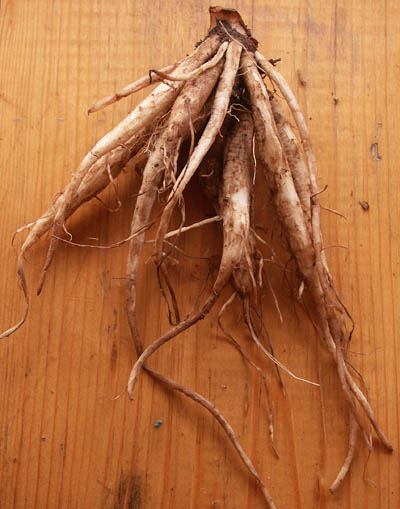
- Yellow/Burdock Root
- White/Daikon Radish
- Black/Shittake Mushrooms
Notes: This is a remedy for all age groups. When the soup is ingested, it produces thirty different elements for fighting disease. Within three days, it can stop the growth of cancer cells. Even for some last-stage cancer patients, it can lead to 100% remission. Patients who have subsisted on feeding tubes for nourishment, when given the soup, after two days regained their strength. Over 10,000 last-stage cancer patients have used this remedy. 99% are alive and were able to return to work. Bottom of Form 1.
Vegetable Soup Recipe - (2 day's quantity)

white daikon

carrots

daikon greens

burdock root

shiitake mushroom
Ingredients: -
- 16 ounces white daikon
- 8-10 ounces white daikon greens
- 8-10 ounces carrot
- 8 ounces burdock root (called Gobo in Japanese, Uang in Korean, Ngao pong or Niu pang in Chinese)
- 3-5 fresh shitake mushrooms (sundried) - if not sundried, expose dried mushrooms to sun again.
Directions: -
1. Don't peel anything! Don't add any seasoning!
2. Fill a pot with three times the quantity of water as the vegetable. When it comes to a boil, reduce the flame and simmer for two hours. Strain and drink.
Brown Rice Tea Recipe
Another remedy that can be used in conjunction with the vegetable soup is brown rice tea. It is a good diuretic for ridding excess water from the body. For diabetics, it can bring the sugar level down by producing more natural insulin in the body. It cleanses the blood and blood vessel. A person with a heart condition drinking both soups in 20 days will be able to regulate their problem by drinking three cups per day. For a regular cancer patient, about two cups.
1.- 1 cup brown rice
2. 16 cups water
Note: only cook in stainless steel or glass. Do not mix with any other ingredients. Don't be "creative."
Directions: -
1. Roast the rice without oil until dark brown but don't burn. Boil 8 cups of water and pour roasted rice into water. Turn off flame, cover and let sit five minutes. Strain out rice and reserve liquid.
2. Boil 8 more cups of water. Put the remaining rice back in the water. Cover, lower flame and simmer five minutes. Strain rice out. Mix the two rice waters together.
Special Notes: -
- The amount one needs depend on the condition. The more serious the condition, the more tea.
- Do not drink tea while taking a high protein substance.
- Don't drink the vegetable soup and brown rice tea together. Wait at least 15 minutes apart.
- If you use this remedy regularly you will never be sick.
Some possible reactions: -
- itchy skin or eczema
- If you use medications and/or have eczema, use less because of stronger reaction
- People with head injury problems may develop headaches but don't worry.
- People with eye problems may get temporary blurred vision or itching around eyes. Eyesight will get better. If you wear prescription glasses, try to reduce the prescription and use glasses less frequently.
- Lowering of body temperature, but this is normal.
Notes: For high blood pressure, drink the two soups alternately but slowly. Blood pressure will come down after one month. Talk to a doctor about reducing medication, but don't stop medication right away. Use remedy for minimum of one month.
Progress of Healing
- After three days of use, cancer cells stop growing.
- After a minimum of one month normal cells begin to grow back.
- Pancreatic Cancer: minimum 1 month
- Stomach Cancer: 1 month
- Liver Cancer: 1 year
- Rheumatism: 1 year
- Cataracts: 4 months
- Eye Disease: 1-4 months
- Insomnia, Sinusitis, Fatigue: 10-20 days
- Eczema: 4-7months
- Liver Spots: 3-6 months skin will clear
- Hair growth: 6-12 months
- Epilepsy: 3-6 months
- Stroke: 6-12 months
- Irregular heart beat: 20 days
Notes: If you are on medication, consult with a doctor to adjust your dosage. This remedy works for some people. It may not work for you. It is not intended to replace the traditional treatments.
Q1: Are ingredients of the vegetable soup recipe measured in fluid ounces or real weights?
A1: Dr. Antonia Martinez Director of the Healing Spirit said that their recipe uses the real weights and not the fluid ounces as in other food recipes.
Q2: Do people using the Vegetable Soup have side effects or reactions?
A2 : Depending on individual bodies, some people using the Vegetable Soup could have side effects/reactions. Reactions are classified in 2 categories: -
Natural Reaction: Ingredients in the Vegetable soup have lots of medicinal effects and contain chemicals that are working on human cells to make them better and stronger, and in the same time purify and cleanse blood stream to push out LDL (bad cholesterol) and fat. Reactions could be itches on the skin, itches around eyes, blurring eyes but these reactions will go away in a few days. If reactions persist stop the HLEF for a few weeks and start again.
Patient or user mistakes could be ranging from: -
- (1) using the wrong kind of ingredients especially the Chinese mushrooms instead of the Japanese Shiitakes.
- (2) the proportion of vegetables making the soup is not followed closely.
- (3) using wrong type of saucepan. Must use stainless steel saucepan to cook.
- (4) vegetable soup left outside in room temperature more than 6 hours can turn out to have bad smelling or color changes to green or white. Throw it away at once. Vegetable Soup should be stored in glass container and refrigerated.
- (5) drinking the Vegetable Soup and the Brown Rice solution together or in the same time. People are reporting serious reactions when taking those two solutions in the same time. Must drink them separately with half-hour or one hour apart.
Q3: How much vegetable soup can one consume a day?
A3: For:
- Diabetes take 600 cc of Brown rice (BR) solution in the morning and 400 cc of Vegetable Soup (VS) in the afternoon.
- Heart problem: 300 cc of BR and 600 cc of VS
- Gall stones: 600 cc of BR and 600 cc of VS.
- Other diseases: About 600 cc (2.5 cups) of VS a day divided in 3 rations before meals.
IMPORTANT NOTE
DO NOT DRINK Vegetable Soup and Brown Rice Solution in the same time. The interval needed between consumption of BR and VS must be at least 30 minutes or 1 hour apart to be safe.
Burdock
This herb gets its name from bur, for its tenacious burrs, and dock old English for plant. Many scientists are skeptical about Burdock and its uses. However, as a healing herb it has a potential for treating cancer. Early Chinese physicians, as well as Ayurvedic healers, used Burdock as a remedy for colds, flu, throat infections and pneumonia. During the 14th Century, its leaves were pounded in wine and used to treat leprosy. From 1930-1950, Burdock was used as an ingredient in alternative cancer treatments.
The FDA noted that too much of this herb can cause side effects and lists Burdock as an herb of "undefined safety". However, German researchers have discovered fresh Burdock root contains polyacetylenes, a chemical that kills disease-causing bacteria and fungi. It also reduces mucus and prevents formation of gall and kidney stones. As Burdock contains vitamin A and selenium, it can eliminate free radicals.
Its chromium content helps regulate blood sugar levels. Other qualities of this herb, set forth in the magazine Chemotherapy, identified a chemical (arctigenin) in Burdock which acts as an inhibitor of tumor growth.
!!! This herb should not be used by pregnant women.!!!
History
Burdock is also known by the names Bardane, Clotburr, Beggars Buttons, Gypsy Rhubarb, Gobo, and Burr. In traditional herbal texts, Burdock Root is described as a "blood purifier" or "alterative", and was believed to clear the bloodstream of toxins.
Medicinally, Burdock Root has been used both internally and externally for eczema and psoriasis, as well as to treat painful joints and as a diuretic.
In traditional Chinese medicine, Burdock Root, in combination with other herbs, is used to treat sore throats, tonsillitis, colds, and even measles.
It is eaten as a vegetable in Japan and elsewhere. Burdock is a mild laxative. It also aids in the elimination of uric acid. The herb contains polyacetylenes that have both anti-bacterial & anti-fungal properties. By improving the function of many organs of elimination (liver, kidneys, bowels), many health conditions can be improved.
Burdock Root contains high amounts of inulin and mucilage. This may explain its soothing effects on the gastrointestinal tract. Bitter constituents in the root may also explain the traditional use of Burdock to improve digestion. The polyacetylene constituents have also been shown to have anti-microbial activity. Burdock Root (and the fruit) also has the ability to mildly lower blood sugar (hypoglycemic effect).
Medicinal Action and Uses
Alterative, diuretic and diaphoretic. One of the best blood purifiers. In all skin diseases, it is a certain remedy and has effected a cure in many cases of eczema, either taken alone or combined with other remedies, such as Yellow Dock and Sarsaparilla.
The root is principally employed, but the leaves and seeds are equally valuable. Both root and seeds may be taken as a decoction of 1 OZ. to 1 1/2 pint of water, boiled down to a pint, in doses of a wineglassful, three or four times a day.
The anti-scorbutic properties of the root make the decoction very useful for boils, scurvy and rheumatic affections, and by many it is considered superior to Sarsaparilla, on account of its mucilaginous, demulcent nature; it has in addition been recommended for external use as a wash for ulcers and scaly skin disorders.
An infusion of the leaves is useful to impart strength and tone to the stomach, for some forms of long-standing indigestion.
When applied externally as a poultice, the leaves are highly resolvent for tumours and gouty swellings, and relieve bruises and inflamed surfaces generally. The bruised leaves have been applied by the peasantry in many countries as cataplasms to the feet and as a remedy for hysterical disorders.
From the seeds, both a medicinal tincture and a fluid extract are prepared, of benefit in chronic skin diseases. Americans use the seeds only, considering them more efficacious and prompt in their action than the other parts of the plant. They are relaxant and demulcent, with a limited amount of tonic property. Their influence upon the skin is due largely to their being of such an oily nature: they affect both the sebaceous and sudoriferous glands, and probably owing to their oily nature restore that smoothness to the skin which is a sign of normal healthy action.
The infusion or decoction of the seeds is employed in dropsical complaints, more especially in cases where there is co-existing derangement of the nervous system, and is considered by many to be a specific for all affections of the kidneys, for which it may with advantage be taken several times a day, before meals.
Treats certain cancers, prevents diabetes
Burdock's name is a combination of bur, for its spiked seed covers - burrs - that grab onto anything that touches them, and dock, Old English for "plant." Many scientists dismiss burdock as useless, but like its seeds, its reputation as an herbal healing agent clings tenaciously because of its subtle tonic benefits and its intriguing potential as a treatment for cancer.
Throughout history, burdock has been recommended for an astonishing number of illnesses. Ancient Chinese physicians used it to treat colds, coughs, tonsillitis, measles, skin infections and snakebite. Traditional European and American herbalists and homeopaths prescribed it for colds, arthritis, gout, stomach problems, fever, canker sores, leprosy, boils, gonorrhea, ringworm and infertility. They also considered it an excellent diuretic, and prescribed it for urinary tract infections, kidney problems and painful urination.
True, burdock is not powerfully therapeutic. But Daniel B. Mowrey, PhD, director of the American Phytotherapy Research Laboratory in Salt Lake City, Utah, and author of The Scientific Validation of Herbal Medicine, insists that it deserves its enduring place in herbal healing because of its value as a tonic - a subtle strengthener with cumulatively helpful effects.
"Burdock's action is mild, but real," Dr. Mowrey explains. "It has antibacterial and antiviral powers, and it reduces blood sugar, which helps prevent diabetes. I recommend using a little every day. And when you're ill, use it in addition to standard therapies."
With Compliments from Chong Min Liong